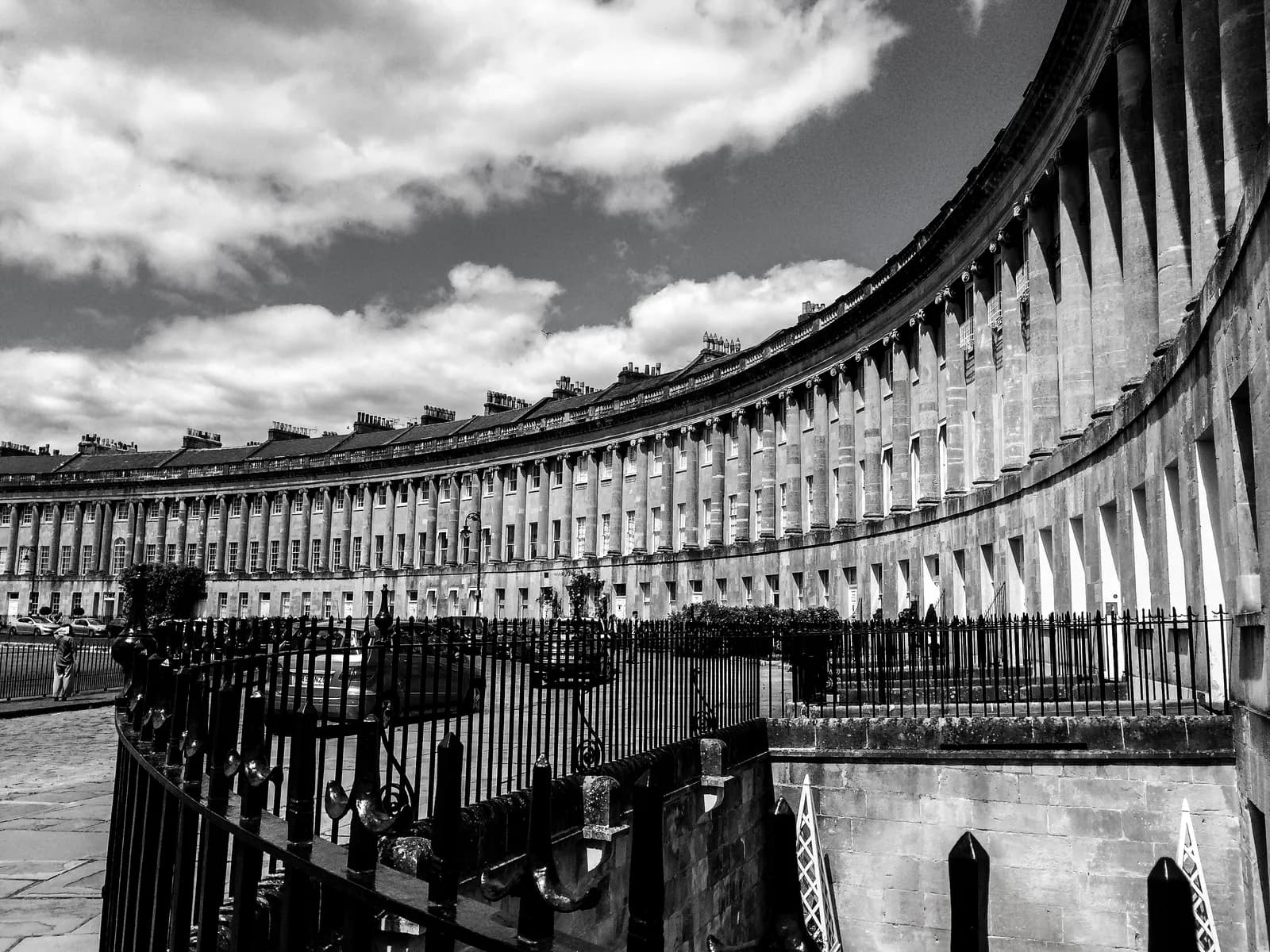
For the 200-odd people who call it home, the Royal Crescent is both privilege and predicament. They reside within perhaps the most photographed Georgian façade in Britain; a sweeping 500-foot curve of Bath stone and Ionic columns that draws visitors from across the globe, yet functions as a residential street where council tenants and millionaires live behind the same uniform frontage.
A Palladian Masterpiece
Built between 1767 and 1774 by John Wood the Younger, the Royal Crescent was Europe's first urban crescent. Its thirty terraced houses sit atop a slope overlooking Royal Victoria Park, separated from the green by a ha-ha designed to be invisible from the lawn. The structure comprises 114 Ionic columns, each 76 centimetres in diameter and rising 14.3 metres, supporting a five-foot-deep Palladian entablature.
The Crescent was originally named simply "The Crescent"; the "Royal" prefix was added after Prince Frederick, Duke of York and Albany, rented No. 1 and later purchased No. 16. Grade I listed since 12 June 1950, it helped secure Bath's UNESCO World Heritage designation in 1987, with UNESCO citing the Crescent as exemplifying "the 18th century move away from the inward-looking uniform street layouts... towards the idea of planting buildings and cities in the landscape."
Queen Anne Fronts and Mary-Anne Backs
The Crescent's most distinctive feature is not visible from the street. John Wood sold lengths of the uniform façade to purchasers, who then employed their own architects for the houses behind. The result is the architectural phenomenon known locally as "Queen Anne fronts and Mary-Anne backs"; from the front, perfect Georgian symmetry, from the rear, a jumble of rooflines, wings, and varying designs.
This quirk continues to define the Crescent today. Of the thirty townhouses, ten remain full-size family homes, eighteen have been subdivided into flats, No. 1 operates as a museum, and Nos. 15 and 16 house The Royal Crescent Hotel and Spa.
From Aristocratic Salons to Council Housing
The Crescent's social history spans the full spectrum. Elizabeth Montagu hosted meetings of the Blue Stockings Society at No. 16, the literary salon that championed women's intellectual pursuits. William Wilberforce, the abolitionist, stayed at No. 2 in 1798. Isaac Pitman, inventor of the shorthand system, lived at No. 17. Elizabeth Ann Linley, the celebrated singer who eloped with playwright Richard Brinsley Sheridan, grew up at No. 11 where her father ran a music school.
After the Second World War, the social composition shifted dramatically. Numbers 2 and 17 were gutted by incendiaries during the Bath Blitz. Bath City Council acquired several properties as public housing under postwar reconstruction programmes. While subsequent sales returned most to private ownership, one house remains council-owned today. As The Independent reported in 1994, "not all residents are millionaires; one house is a council house."
The Museum and the Hotel
No. 1 Royal Crescent operates as a historic house museum owned by the Bath Preservation Trust. Purchased in 1967 by Major Bernard Cayzer and donated with restoration funds, it opened following renovation by architect Philip Jebb. The house is furnished to reflect the period 1776 to 1796, when Henry Sandford, 1st Baron Mount Sandford, was its first tenant. In 2012 and 2013, the Trust reunited the house with its original servants' wing at No. 1A, creating a rare complete Georgian townhouse experience. The museum was named Best Small Visitor Attraction in England by VisitEngland in 2025.
The Crescent has found renewed fame as the exterior of the Featherington family home in Netflix's Bridgerton, with filming taking place as recently as January 2023 for Season 3.
Nos. 15 and 16, combined in 1971, form The Royal Crescent Hotel and Spa. The property offers 45 rooms and suites, a three-AA-Rosette restaurant named Montagu's Mews, and a spa with pool. The hotel has passed through several owners since being sold to John Tham in 1978, including a period under Von Essen Hotels until that company's insolvency in 2011. Topland Group purchased the property in April 2012.
Life Behind the Façade
The Royal Crescent Society was established in 1973 to represent residents' interests and foster community spirit. Its leadership has included Air Chief Marshal Sir John Barraclough as President and the Earl of Stockton as Vice-President.
Living in such a prominent location brings unique pressures. By 1994, up to ten open-top double-decker tourist buses passed through the Crescent each hour, prompting the Society to campaign for restrictions. Bath and North East Somerset Council ultimately banned coaches and buses from the Crescent entirely following years of complaints about disruptive tour commentary and road damage estimated at more than £200,000.
Even domestic details have generated controversy. In the 1970s, resident Amabel Wellesley-Colley painted her front door yellow. After a court case, the Secretary of State for the Environment ruled the door could remain yellow; it stands out still.
Preservation and the Future
The Crescent's cast-iron railings, installed in the late 19th century and Grade II listed in 2010, underwent a £280,000 restoration project beginning in August 2008, funded partly by a £50,000 grant from English Heritage. The Bath Preservation Trust, as freeholder of several properties including No. 1, remains central to conservation efforts.
Current residents inhabit a street that functions simultaneously as private housing, public museum, luxury hotel, and UNESCO World Heritage Site. It is a place where Georgian architectural purity confronts the practicalities of modern life; where television crews, preservationists, and families going about their daily routines must coexist within a structure designed when George III was on the throne.
The Royal Crescent remains, as UNESCO described it, a "demonstration par excellence" of Palladian principles. For those living inside this particular postcard, that demonstration continues seven days a week.