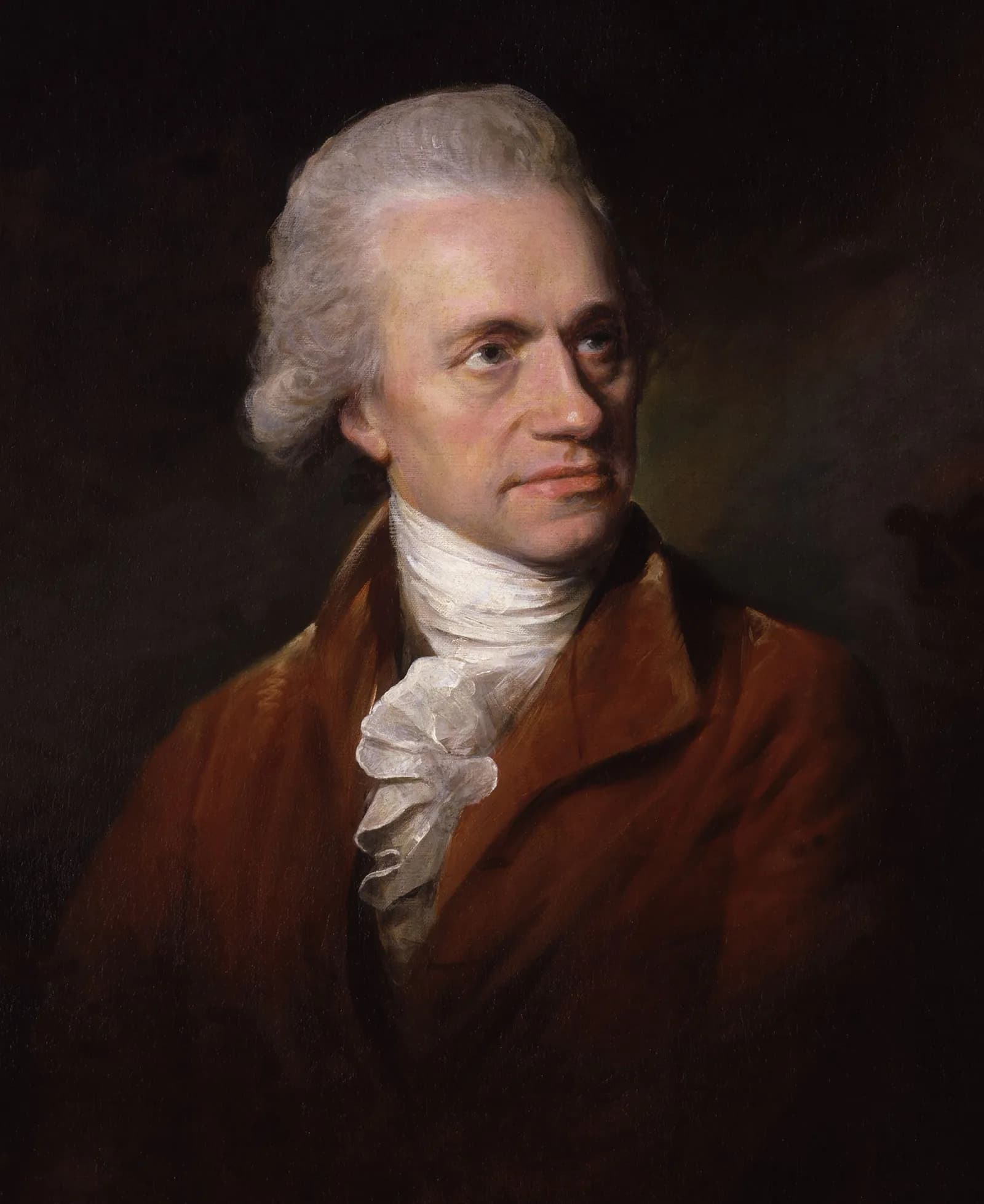
On the night of 13 March 1781, from the modest garden of his townhouse at 19 New King Street, musician William Herschel made a discovery that would fundamentally reshape humanity's understanding of the cosmos.
The Organist and His Telescope
When Herschel moved into the Grade II* listed house on New King Street in 1777, he was already established as a respected figure in Bath's musical circles. Since 1766, he had served as organist at the Octagon Chapel, and by 1780 he had become director of the Bath orchestra. His sister Caroline, who joined him in Bath in 1772, often performed as soprano soloist in the concerts he organised.
Yet Herschel's interests extended far beyond music. In 1766, he had begun reading Robert Smith's Harmonics, followed by A Compleat System of Opticks, which introduced him to the principles of telescope construction. Working from a workshop in his basement, Herschel began grinding and polishing his own mirrors from disks of copper, tin, and antimony.
The telescope that would change astronomy was entirely of his own manufacture: a reflecting telescope with a 6.2-inch (160 mm) aperture and a 7-foot (2.1 m) focal length, employing an f/13 Newtonian design. Herschel's strongest eyepieces could achieve magnifying powers of up to 5,787 times.
A Comet That Was Not a Comet
On that March evening, Herschel was engaged in what he described as "a series of observations on the parallax of the fixed stars" when he noticed an object that appeared distinctly different from the surrounding celestial bodies. Initially, he suspected he had found a comet, or possibly a stellar disc that he might resolve into individual stars.
On 26 April 1781, Herschel reported his findings to Nevil Maskelyne, the Astronomer Royal. The object's movement, however, did not conform to the expected behaviour of a comet. Finnish-Swedish astronomer Anders Lexell computed the object's orbit and determined it was almost certainly planetary. Herschel soon reached the same conclusion: he had discovered a planet beyond Saturn, the first such discovery in recorded history.
Doubling the Known Universe
The significance of Herschel's discovery cannot be overstated. It was the first planet discovered since antiquity, and the first ever found with the aid of a telescope. The discovery effectively doubled the known size of the Solar System; Uranus orbits at approximately twice the distance from the Sun as Saturn.
What makes the achievement all the more remarkable is that Uranus had been observed multiple times before Herschel's discovery, but always misidentified as a fixed star. The astronomer John Flamsteed had observed it at least six times in 1690, cataloguing it as 34 Tauri. James Bradley, Tobias Mayer, and Pierre Charles Le Monnier had all recorded sightings between 1748 and 1769, with Le Monnier observing it on at least twelve occasions including four consecutive nights.
From Musician to Royal Astronomer
Herschel's discovery brought immediate recognition. In 1781, he was awarded the Copley Medal and elected a Fellow of the Royal Society. The following year, King George III appointed him "The King's Astronomer" with an annual pension of £200, allowing Herschel to abandon his musical career and devote himself entirely to astronomy.
On 1 August 1782, Herschel and Caroline left Bath for Datchet, near Windsor Castle. The house at 19 New King Street remained home to Caroline and their brother Alexander until 1784. Today, the property operates as the Herschel Museum of Astronomy, opened on 13 March 1981 to mark the bicentenary of the discovery.
Herschel proposed naming the new planet "Georgian star" (Georgium sidus) in honour of his royal patron. The name failed to gain acceptance outside Britain; in France, the planet was known simply as "Herschel" until the name "Uranus", after the Greek primordial deity of the sky, was universally adopted approximately seven decades later.
The Bath Legacy
Herschel's discovery from a townhouse garden demonstrated that profound scientific breakthroughs need not originate from grand institutions or royal observatories. His legacy continued through further discoveries: Titania and Oberon, moons of Uranus, in 1787; Enceladus and Mimas, moons of Saturn, in 1789; and in 1800, the detection of infrared radiation through experiments with sunlight and prisms.
For Bath, the discovery remains a point of singular pride: the moment when a German-born musician, working from his garden on a quiet Georgian street, revealed a world that had remained hidden since the dawn of human civilisation.