From Tontine Scheme to Cultural Cornerstone
The Theatre Royal Bath opened on 12 October 1805 with a performance of Shakespeare's Richard III, replacing the Old Orchard Street Theatre which had held the first royal patent granted outside London. Built in Sawclose to designs by George Dance the Younger, with construction supervised by Bath City Architect John Palmer, the theatre was funded through a tontine scheme in which shares cost £200 each; subscribers included the Prince Regent and Prince Frederick, Duke of York.
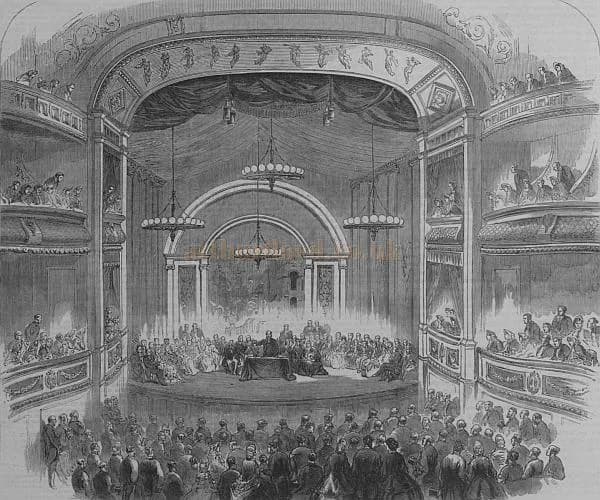
Its horseshoe auditorium originally accommodated roughly 900 spectators across three galleries. The Theatres Trust now lists the building as Grade II*, describing it as "one of the most important surviving examples of Georgian theatre architecture." Yet that architectural distinction has never insulated it from financial peril.
Fire, Decline and Rebirth
The theatre's survival was first tested within decades of its opening. Attendance fell during the 1820s to 1850s, and closure was threatened on several occasions. A more dramatic blow arrived on 18 April 1862, when a fire destroyed the interior, including the stage, scenery, wardrobe and library; only the exterior walls were left standing.
Rebuilding began immediately. Architect Charles J. Phipps supervised the restoration, adding a new entrance on Sawclose, and the theatre reopened on 3 March 1863 with A Midsummer Night's Dream starring Ellen Terry and Charles Kean. The Edwardian era brought further modernisation: in 1902 the building closed for nine months so that a new staircase, electric lighting, a fire curtain and hot-water radiators could be installed.
The Twentieth-Century Rescue
The Great Depression hit the theatre hard. It was not profitable during the 1930s and closed completely for six months. By the 1970s the building had fallen into serious disrepair, passing through the hands of property developers Charles Ware and Charles Clarke before Louis I. Michaels acquired it.
The turning point came in March 1979, when a trust headed by the engineer and philanthropist Jeremy Fry purchased the dilapidated building for £155,000. Between 1980 and 1982 a £3.5 million renovation was carried out, £1.8 million of which was deemed essential. The work included a new fly tower, rebuilt stage and modern lighting grid. On 30 November 1982 the theatre reopened with the Royal National Theatre's production of A Midsummer Night's Dream starring Paul Scofield; Princess Margaret, Countess of Snowdon, attended the gala performance.
Modernisation Without Subsidy
Unlike most regional theatres, the Theatre Royal Bath receives no core Arts Council subsidy. It describes itself as the "UK's leading unsubsidised producing venue," relying instead on ticket sales, membership schemes such as the 1805 Club, donations, corporate support and trusts.
That independent model has demanded constant reinvention. In 1997 the 120-seat Ustinov Studio opened, named after the actor Peter Ustinov, and in 2005 the Egg children's theatre was added on 23 October 2005. The most extensive refurbishment since the 1980s took place in 2010, costing £3 million. It expanded the foyer, improved disabled access, installed a new lift and air-conditioning, and reduced the building's carbon footprint by 30 per cent. The reopening on 8 September 2010 was marked by a production of The Rivals starring Penelope Keith and Peter Bowles. Camilla, Duchess of Cornwall, who is the theatre's Royal Patron, launched the 2010 Refurbishment Appeal.
Pandemic and the Present Day
The theatre closed its doors on 16 March 2020 as COVID-19 lockdown measures took effect. It became one of the first regional theatres to reopen, staging Harold Pinter's Betrayal in September 2020 with Ralph Fiennes in the cast. The organisation received a third grant from the government's Culture Recovery Fund to help ensure performances could continue throughout 2021.
Today the Theatre Royal operates three auditoria: the Main House, which hosts year-round touring productions, comedy, opera, dance and pantomime; the Ustinov Studio, which stages in-house and small-scale touring work; and the Egg, dedicated to theatre for children and young people. Current leadership includes Director Danny Moar, Executive Producer Nicky Palmer and Chairman Paul Heal. The summer season, curated by Jonathan Church since 2017, continues the tradition begun by the Peter Hall Company Season in 2003.
After more than two centuries of fire, depression, dereliction and pandemic, the theatre remains a working landmark. Its survival has depended not on a single benefactor but on successive generations of Bath residents, performers and trustees who have judged the building worth the repeated cost of rescue.